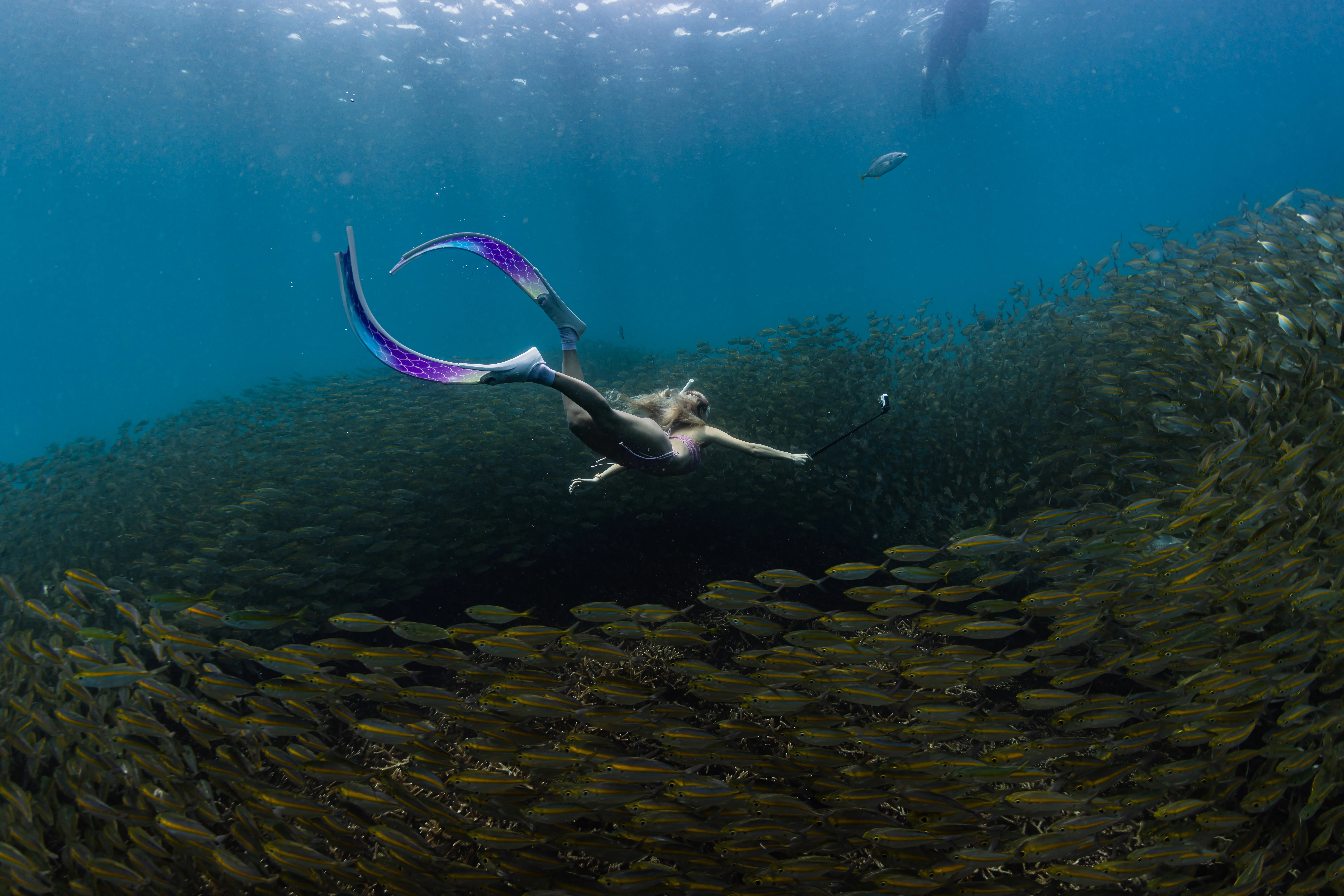
Ask any experienced diver in the Gulf of Thailand to name the single best dive site in the region, and they will almost certainly say Sail Rock. Ask a freediver the same question, and the answer comes even faster. There is nothing else like it.
Sail Rock is a massive granite pinnacle that rises from depths of over 40 meters and breaks the ocean surface as a lone tower of rock in the middle of open water. It sits roughly halfway between Koh Phangan and Koh Tao, visible from a distance as a small gray spike on the horizon. From above, it does not look like much. From below, it is one of the most impressive underwater structures in all of Southeast Asia.
This guide covers everything you need to know about freediving at Sail Rock from Koh Samui. The underwater terrain. The chimney. The marine life. The whale sharks. The conditions. And the practical details of getting there and back.
The Underwater Terrain
Sail Rock is not a single rock. It is a complex underwater mountain with multiple pinnacles, ridges, and boulders scattered across the seafloor. The main pinnacle breaks the surface, standing about 10 meters above water, but the real structure extends far below.
From the surface, the rock walls drop almost vertically to about 20 meters. Below that, the gradient becomes less steep, with boulder fields and sandy patches extending to the seafloor at 40 meters or deeper on the eastern side. The western side is slightly shallower, with interesting features starting at 5 meters and continuing to about 30 meters.
The entire structure is covered in marine growth. Barrel sponges the size of bathtubs cling to the walls. Massive sea anemones host families of clownfish at various depths. Soft corals in purple, orange, and yellow drape every available surface. Gorgonian sea fans spread their delicate networks across the current, filtering plankton from the water. The visual density of life on these walls is genuinely staggering.
For a freediver, the terrain offers something at every depth. Shallow divers (5 to 10 meters) can explore the upper walls where light penetrates fully and the colors are most vivid. Mid range divers (10 to 20 meters) reach the swim throughs and overhangs where larger fish shelter. Deep divers (20 to 40 meters) access the boulder fields and the base of the pinnacle where the biggest marine life tends to gather.
The Chimney
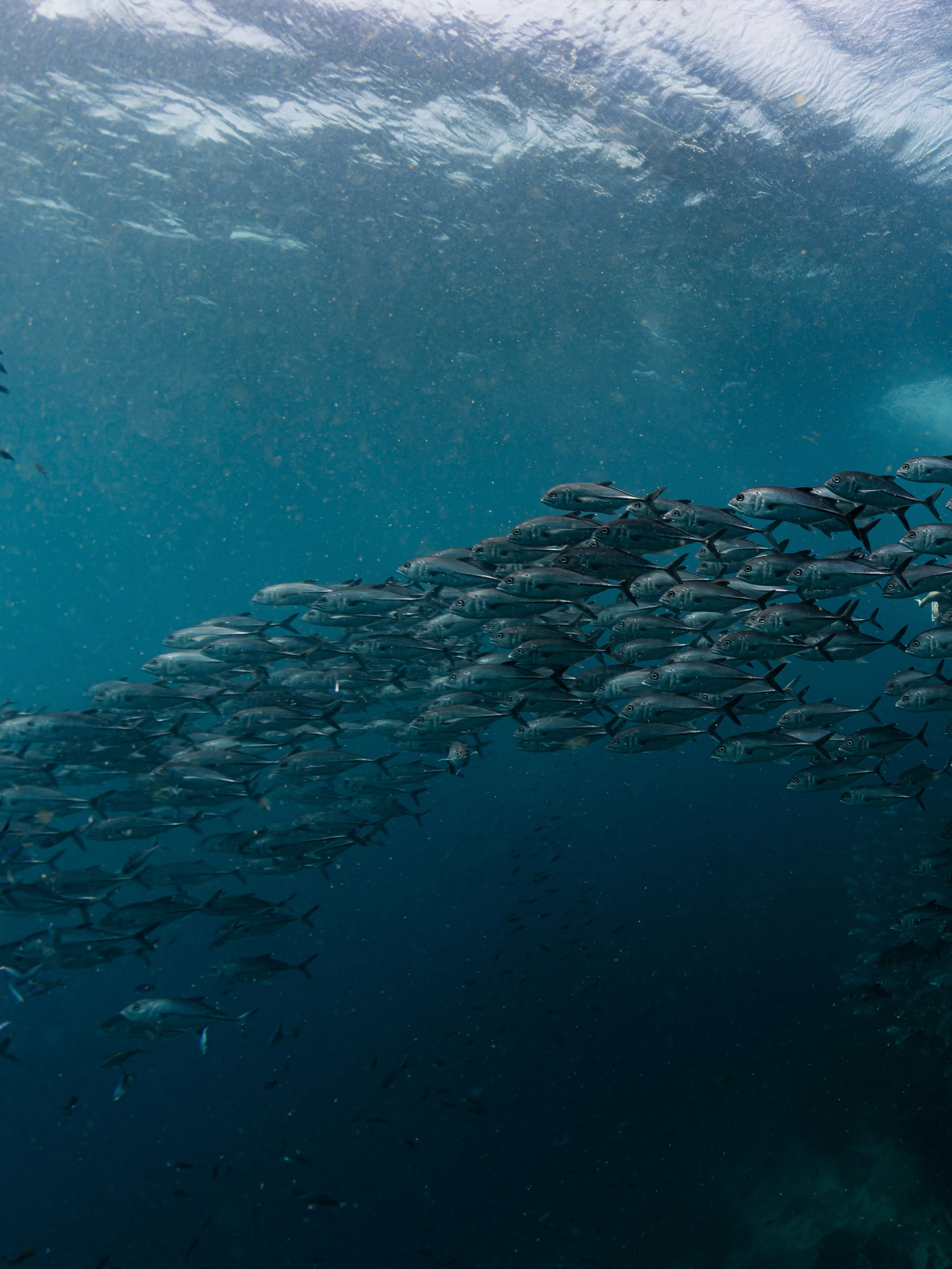
The chimney is what separates Sail Rock from every other dive site in Thailand. It is a vertical swim through passage that cuts through the main pinnacle from approximately 18 meters deep to about 5 meters below the surface. The passage is roughly 2 meters wide at its widest point and narrows in places.
For scuba divers, the chimney is a straightforward swim through. For freedivers, it is something else entirely. You enter from below on a single breath, ascending through a narrow rock tunnel with walls covered in marine life on all sides. As you rise, the light increases. The opening above you grows brighter. You emerge into open water near the surface with sunlight pouring down and the blue ocean stretching in every direction.
The experience of ascending through the chimney on a breath hold is difficult to describe to someone who has not done it. There is a feeling of being inside the rock itself, enclosed by ancient granite covered in living color, with the surface world visible as a circle of light above you. It combines the thrill of depth with the beauty of the reef and the satisfaction of completing a challenging physical and mental task on a single breath of air.
To attempt the chimney safely as a freediver, you need to be comfortable at 18 to 20 meters depth. You need reliable equalization skills that work consistently, not just sometimes. And you need the discipline to turn back if anything feels wrong. The chimney is not a place to push your limits. It is a place to enjoy your capabilities within a comfortable margin of safety. Our guide assesses each guest individually and only suggests the chimney for those who demonstrate the required skills during warm up dives on the outer walls.
Marine Life at Sail Rock
The marine life at Sail Rock is exceptional by any standard. The pinnacle acts as an oasis in the open ocean, attracting everything from tiny nudibranchs to the largest fish in the sea.
The resident population includes several species you will see on nearly every visit. Chevron barracuda form enormous schools that spiral above the pinnacle in tornado shaped columns. These columns can be 10 meters tall and contain hundreds of individual fish. Swimming up through a barracuda tornado on a freedive is an experience that borders on surreal.
Giant groupers live in the crevices and overhangs around the base of the pinnacle. Some of these fish are genuinely huge, well over a meter long and as thick as a car tire. They are territorial but not aggressive, and they will let a quiet freediver approach within a few meters before slowly retreating into their lair.
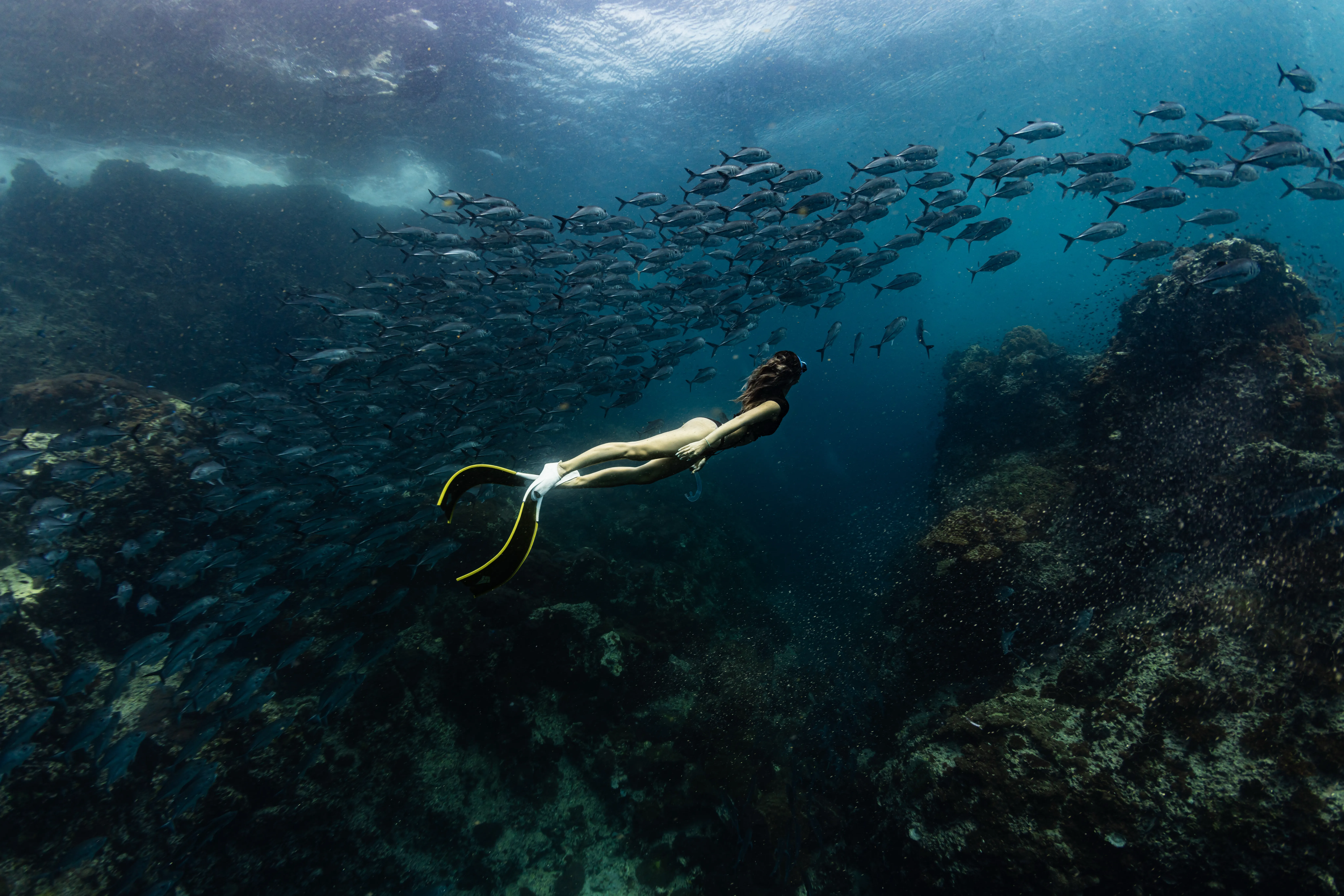
Batfish patrol the mid water column in groups of 20 to 50 individuals. These flat, disc shaped fish are curious about divers and will sometimes approach to investigate, which gives you the strange experience of being studied by a wall of round silver faces.
Other regular sightings include giant trevally hunting in pairs, clouds of fusiliers that part and reform around you as you dive through them, moray eels peering from holes in the rock, and an astonishing variety of nudibranchs and flatworms on the walls for those who look closely.
Whale Shark Season
The whale sharks are what draw many divers to Sail Rock, and the season runs roughly from March through May, sometimes extending into June if conditions are favorable. During these months, whale sharks visit the pinnacle to feed on the plankton that accumulates in the nutrient rich water around the rock.
Whale sharks are the largest fish in the ocean, reaching lengths of 12 meters or more. Despite their size, they are filter feeders and completely harmless to humans. They move slowly through the water with their enormous mouths open, scooping up plankton and small fish. Encountering one while freediving is an experience that sits in its own category of human experience.
When a whale shark arrives at Sail Rock, the water seems to change. Everything gets quiet. The schooling fish scatter and reform. And then this impossible shape materializes out of the blue, covered in white spots, moving with a slow grace that defies its massive size. As a freediver, you can dive down and swim alongside it at its own pace, matching its gentle movement for a few precious seconds before surfacing for air.
We cannot guarantee whale shark encounters on any particular trip. Nature does not work on a schedule. But during peak season, the odds are genuinely good. Some weeks we see whale sharks on multiple consecutive trips. Other weeks, nothing. If seeing a whale shark is a priority for your trip, booking during March through May gives you the best chance, and we recommend flexibility with your dates so we can choose the day with the best conditions and the most recent sighting reports.
Getting to Sail Rock from Koh Samui
Sail Rock sits in open water between Koh Phangan and Koh Tao. From Bangrak Pier on Koh Samui, the boat ride takes approximately one hour by private speedboat. The route heads northeast past the northern tip of Koh Samui, across the open water past Koh Phangan, and on to the pinnacle.
The one hour crossing is one of the shorter charter routes, and it is worth discussing honestly. On a calm day, the ride is beautiful. You cross open water that changes from green nearshore to deep blue as the depth increases. Flying fish sometimes burst from the surface ahead of the boat. Koh Phangan slides past on your left, and then there is nothing but open ocean until Sail Rock appears on the horizon.
On a choppy day, the crossing can be bumpy. The open water between the islands is exposed to wind and swell, and the boat pitches and rolls. If you are prone to seasickness, take precautions before departure. Motion sickness medication, ginger, and wristbands all help. We also recommend eating a light breakfast rather than a heavy one, and sitting toward the back of the boat where the motion is less pronounced.
The captain makes the call on departure day based on weather conditions. If the sea state makes the crossing unsafe or uncomfortable, we suggest alternative destinations closer to Koh Samui. This has happened on maybe one in ten planned Sail Rock trips over the years. Safety always comes first.
Best Conditions for Freediving at Sail Rock
The best freediving conditions at Sail Rock come together when several factors align: calm seas for the crossing, minimal current at the site, good visibility, and ideally a flood tide that pushes clear water from the open ocean toward the pinnacle.
Visibility at Sail Rock ranges from 10 to 30 meters depending on the day. On a clear day, you can see the entire pinnacle structure from the surface, with the chimney entrance visible as a dark opening in the rock face 18 meters below. On a murky day, visibility might drop to 10 meters, which is still good diving but changes the character of the experience.
Current varies significantly. Some days the water around the pinnacle is nearly still, which makes for relaxed diving where you can hover at depth and take your time. Other days, current runs parallel to the rock face, which requires more effort and awareness but often brings better marine life. The current delivers nutrients that attract fish, so the trade off is usually worth it.
The best months overall are March through May. This period combines the calmest sea conditions, the clearest water, the warmest temperatures (29 to 30 degrees Celsius), and whale shark season. If you can only dive Sail Rock once, do it during these months.
June through September is the secondary season. Conditions are still good most days, but occasional squalls from the southwest monsoon can make the crossing rougher. Visibility remains high, and the marine life is just as impressive. Whale sharks become less frequent after May but are not unheard of through June.
October through February is the most variable period. The northeast monsoon brings stronger winds and larger swells to this part of the Gulf. Sail Rock trips are still possible during calm windows, but cancellations due to weather are more common. If you are visiting during these months, keep Sail Rock as a weather dependent option and have a backup destination in mind.
Who Should Dive Sail Rock
Sail Rock is not a beginner site. This needs to be stated clearly so that expectations are set correctly.
To get the most out of Sail Rock as a freediver, you should be comfortable diving to 15 meters or deeper. You should have reliable equalization that works every time without forcing. You should be comfortable in open water with potential current. And you should have enough experience to manage your energy and breath hold over a full day of repeated dives.
If you can comfortably reach 10 meters but not deeper, you can still enjoy Sail Rock. The upper walls between 5 and 10 meters are covered in marine life and are beautiful to explore. You just will not be able to attempt the chimney or reach the deeper features where the largest marine life tends to gather.
If you are a complete beginner, we recommend starting at a closer and shallower site like Koh Mat Sum or Koh Phangan. Build your skills and confidence there, and save Sail Rock for a future trip when you are ready to experience it fully. Rushing to Sail Rock before you have the skills diminishes the experience and increases unnecessary risk.
For snorkelers who do not intend to freedive deep, Sail Rock can still be impressive. The surface water above the pinnacle is often thick with fish, and looking down from above you can see the structure descending into the blue. But if the primary plan is snorkeling rather than freediving or scuba, other destinations closer to Koh Samui will offer a better overall experience.
Practical Details
The private boat charter to Sail Rock costs 42,000 THB for the full day. This covers a private speedboat with captain and crew, all freediving and snorkeling equipment, a PADI Master Freediver guide, drinks and snacks, and GoPro footage. The boat accommodates up to 12 guests, so splitting the cost among a group makes it very reasonable per person.
A typical Sail Rock day runs from about 7:30 AM to 5:30 PM. You depart Bangrak Pier early, arrive at Sail Rock around 8:30 AM, spend three to four hours diving, and return to Koh Samui in the late afternoon. Lunch is served on the boat between dive sessions.
What to bring: reef safe sunscreen, a hat for the boat ride, sunglasses with a strap, a light jacket or long sleeve shirt for the return trip when the breeze picks up, motion sickness medication if needed, and cash for any incidentals. Everything else is provided.
We recommend booking Sail Rock trips at least a few days in advance, especially during peak season (March through May). This gives us the flexibility to choose the day with the best weather forecast. If conditions force a cancellation, we reschedule at no extra cost or suggest an alternative destination.